The best hiders in Meccha Chameleon are not necessarily the best artists. They are the players who understand spot selection, pose, and color matching — and who know how to waste a seeker's time. This guide breaks down the hider loop step by step.
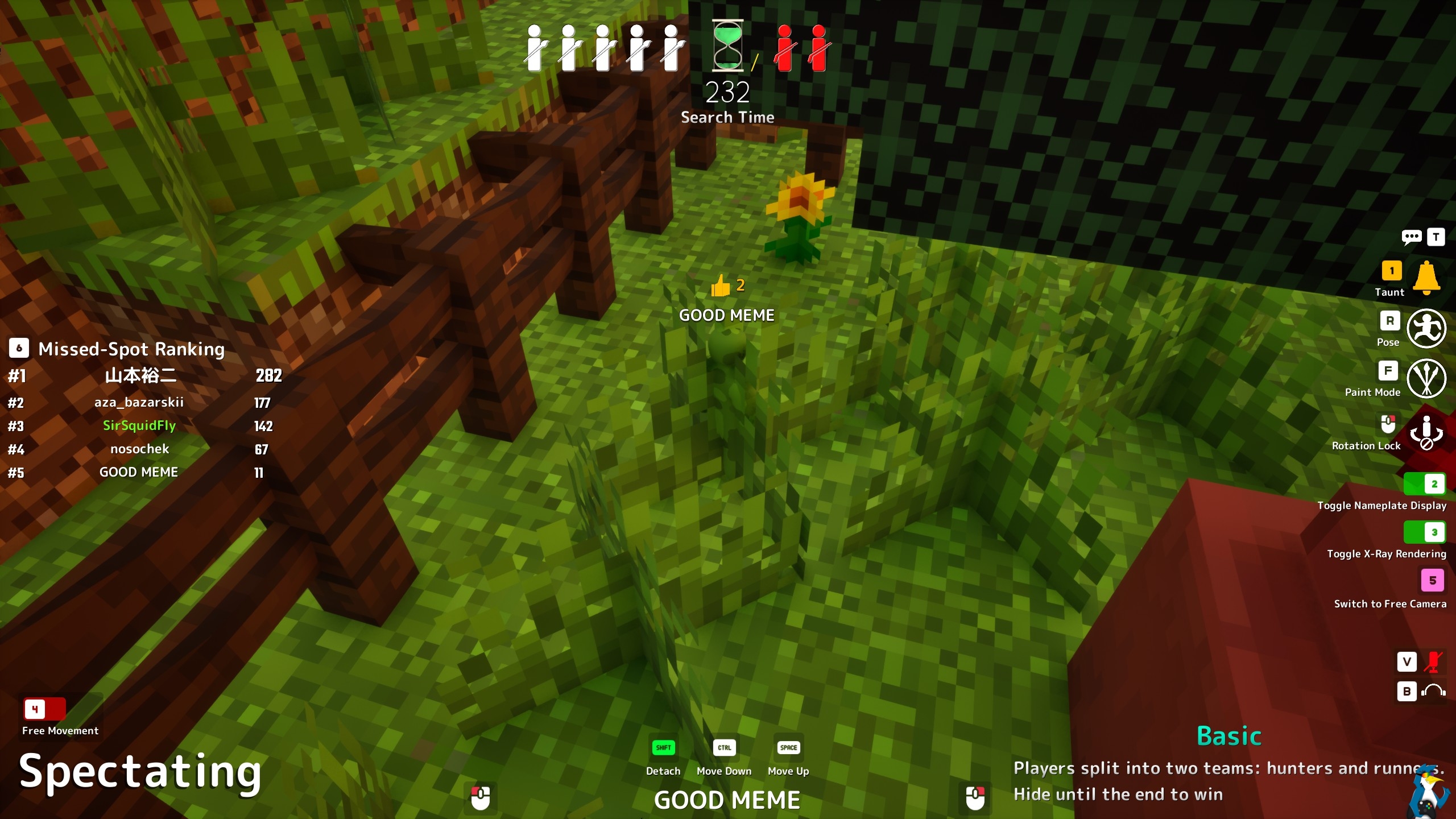
A player painted to blend into tall grass. Strong spot choice + matching colors = a convincing hide.
The hider loop
Every successful hide follows the same four steps:
- Spot — pick a location that makes geometric sense for your body.
- Pose — shape your body so it reads as part of the scenery.
- Paint — copy the colors, shadows, and textures around you.
- Freeze — stop moving once seekers are released.
1. Pick the spot first
New players often start painting before they know where they are going. That wastes the short preparation timer. Instead, decide on your spot within the first few seconds, then use the rest of the time to paint.
Good spots share these traits:
- Visual clutter. Corners with many objects, patterns, or colors make it harder for seekers to isolate your shape.
- Shadows. Seekers have no flashlight. A dim corner hides imperfections in your paint job.
- Believable geometry. Your pose should look like it belongs there — curled into a ball near balloons, flat against a wall, tucked between boxes.
- Multiple viewing angles. Avoid spots that look perfect from one angle but obviously wrong from another.
2. Pose with purpose
Poses break up your human outline. The game offers several poses, and more have been added in updates. Experiment to find poses that match common map objects:
- Curl into a ball — looks like a ball, balloon, rock, or pile.
- Lie flat — works for floors, rugs, paintings, or wall decorations.
- Press against a wall — minimizes depth and casts fewer suspicious shadows.
- Crouch — useful for pretending to be a box, crate, or small prop.
3. Paint for the environment
The eyedropper is your most important tool. Use it to sample:
- A base color from the main surface you are pressed against.
- A darker shade for shadowed edges or undersides.
- A lighter tone for areas that catch the light.
Tips for a convincing paint job:
- Cover large areas first. Use broad strokes to block in the base color, then add details. The brush size can usually be adjusted inside the paint UI. Focus on getting full coverage before the prep timer runs out.
- Do not use a single flat color. Real surfaces have variation. Add subtle stripes, spots, or gradients.
- Match the lighting. A color sampled in shadow will look wrong under a lamp, and vice versa.
- Paint your edges. Unpainted arms, legs, or the back of your head are common giveaways.
- Use the environment. If you are next to a poster, copy part of the poster design onto yourself.
- Blend with more than one object. Pressing against a wall is fine, but lining up with a prop and the surface behind you makes your silhouette more believable.
4. Freeze and stay calm
Movement is the easiest way to get caught. Once the seeker phase starts, stay completely still. If a seeker is close and looking away, you can consider relocating, but only if you are confident you can re-paint quickly at the new spot.
5. Hide well, but not too well
Meccha Chameleon rewards hiders with points when seekers have them in line of sight but do not notice them. A perfectly hidden player may survive, but a slightly visible player can rack up more points. The balance is to stay alive first and earn points second — do not let the scoring game get you shot.
Common hider mistakes
- Hiding in empty corners. A plain wall gives seekers nothing else to look at, so they will study every detail.
- Over-painting details. Sometimes a simple color match is better than an elaborate pattern that draws attention.
- Ignoring the timer. If you are still looking for a spot when seekers are released, you are already losing.
- Being too clever. Hiding in an obvious-but-well-painted spot often works better than a theoretically perfect spot that no seeker would check.