Meccha Chameleon is easy to understand but tricky to master. This guide covers the basics: what each team does, how the painting mechanic works, the three game modes, and a checklist for your first match.
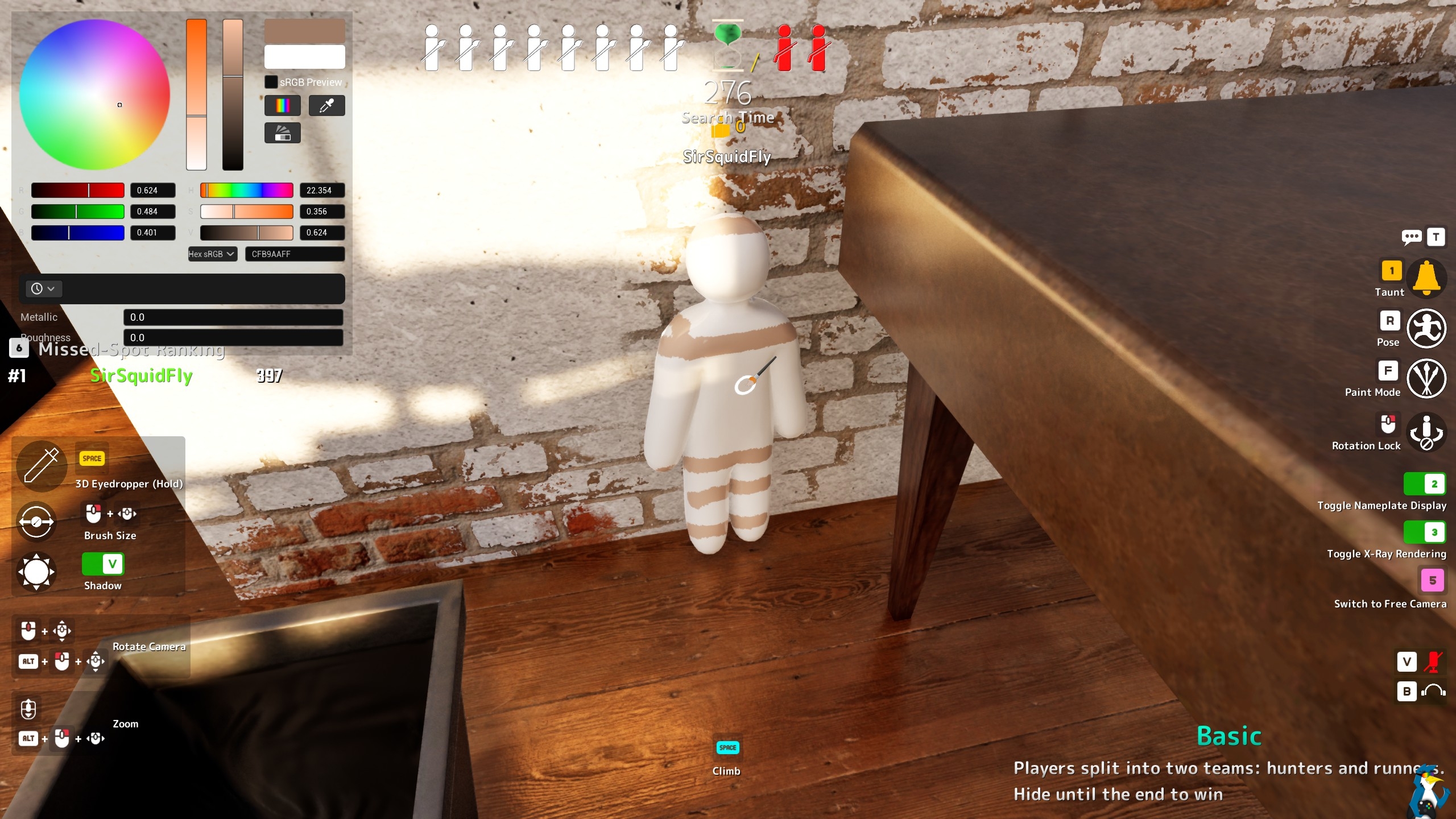
A hider attempts to blend into a wall. Even imperfect paint jobs can confuse seekers for a few crucial seconds.
Core concept
Every round splits players into two teams: Hiders and Seekers.
- Hiders start as plain white characters. During a short preparation phase, they run to a spot, pick a pose, and paint their bodies to match the environment.
- Seekers wait in a locked area during the preparation phase. Once it ends, they are released and must find every hider before the timer runs out.
If even one hider survives until time runs out, the hiders win. If the seekers find everyone, the seekers win.
Hider basics
Your goal as a hider is to be overlooked, not necessarily invisible. Follow this loop:
- Find a spot quickly. Use the preparation timer. Lock in your location early so you have time to paint.
- Pick a pose. Open the pose menu with R, then curl into a ball, lie flat, press against a wall, or mimic a nearby object. The right pose breaks up your human silhouette.
- Paint your body. Open the paint menu with F, use the eyedropper to sample colors from the environment, and cover yourself. Add shadow and highlight tones — a flat single color is usually easy to spot. Use the left mouse button to apply paint.
- Freeze. Once the seekers are released, movement is the biggest giveaway. Stay still unless you are sure no seeker is nearby.
Seeker basics
As a seeker, you are looking for anything that does not belong. Experienced players scan for:
- Shape mistakes — human outlines, extra limbs, or objects that look "too clean."
- Spacing errors — gaps that are too wide or narrow in repeating patterns.
- Shadow mismatches — a painted player may match the color but not the lighting.
- Movement — any twitch or shift is an instant giveaway.
For a deeper breakdown, read the seeker tips page.
Controls
| Action | Common default key |
|---|---|
| Move | WASD |
| Look / camera | Mouse |
| Jump | Space |
| Crouch | Ctrl |
| Open paint menu | F |
| Open pose menu | R |
| Apply paint / seeker tag | Left mouse button |
| Rotate camera while painting | Middle mouse button |
| Chat | T |
| Menu / settings | Esc |
Some poses let you stick to walls or props. When that prompt appears, Space and Ctrl usually adjust your position up or down, and Shift releases the stick. These prompts are shown on the HUD, so follow the live hint rather than memorizing a key.
Game modes
Meccha Chameleon has three main modes. The host chooses which one to play.
Normal (Classic)
The standard rules described above. Hiders hide, seekers hunt. This is the best mode for learning the game. Some community sources call this mode Classic.
Infection
When a hider is found, they join the seeker team. The number of seekers snowballs, forcing the remaining hiders into tighter and tighter spaces. This mode is most tense with 6–10 players.
Double (Speed Hunt)
Everyone hides first, then everyone becomes a seeker and races to find the other players fastest. The winner is whoever finds the most hiders in the shortest time. Some sources refer to this mode as Speed Hunt.
First-match checklist
- Pick Mansion or Indoor Country for your first map — the surfaces are easier to read.
- As a hider, aim to survive 60 seconds, not to win the round.
- Use the eyedropper on the wall or floor near your spot before you start painting.
- As a seeker, move slowly along walls instead of spinning in the center of a room.
- Watch the post-match reveal to learn where other players hid.